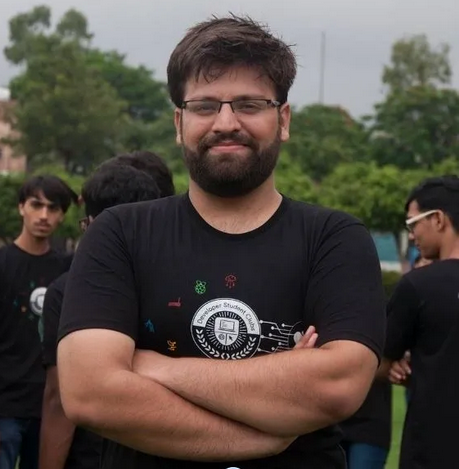
Hi, I'm Saksham Madan.
A
Senior Robotics & Flight Control Engineer with 6+ years building autonomous UGV/UAV systems from simulation to real-world deployment. Expert in swarm intelligence, SLAM, Digital Twins, and DO-178C safety-critical software. Currently pursuing MS by Research at IIT Delhi.
About
I am a Senior Flight Control Engineer at Anadrones System Pvt. Ltd. and a Research Scholar (MS by Research) at the Indian Institute of Technology, Delhi. I specialise in autonomous systems — from swarm drone control on military-grade platforms to SLAM-based UGV navigation and high-fidelity Digital Twin development using NVIDIA Isaac Sim and Omniverse With 6+ years of hands-on experience spanning IIT Delhi, People Tech Group, Veda Aeronautics, and IISER Bhopal, I have led teams of up to 8 engineers to deliver safety-critical autonomous solutions aligned with DO-178C standards. My work sits at the intersection of robotics, deep learning perception, sensor fusion, and embedded systems deployment on NVIDIA Jetson hardware.
- Languages: C, C++ (11/14/17), Python, Embedded C, CUDA
- Frameworks & Middleware: ROS1/ROS2, TensorFlow, Keras, PyTorch, OpenCV
- Simulation: NVIDIA Isaac Sim, Omniverse, Gazebo, AirSim, V-REP
- Specialisations: SLAM, Sensor Fusion (LiDAR/RGB-D/IMU), Swarm Intelligence, Motion Planning, MPC, VIO, Point Cloud Processing, DO-178C
- DevOps: Docker, CI/CD, Git
- Hardware: NVIDIA Jetson Series, Pixhawk, ArduPilot, STM32, Raspberry Pi, OmniBusF9
I am passionate about building robotic systems that operate safely and reliably in the real world — from tiger reserves to defence applications. Currently open to research collaborations and senior engineering roles in autonomous systems, defence robotics, and embodied AI.
Experience

- Designed swarm intelligence algorithms for military-grade QinetiQ Banshee target drones; coordinating 5+ agents with real-time trajectory and motion planning at speeds exceeding 200 km/h.
- Built ROS2 control architecture with fault tolerance and dynamic reconfiguration under DO-178C safety standard; reduced critical software defect rate by 35%.
- Developed Digital Twins of UAV platforms in NVIDIA Isaac Sim and Omniverse with high-fidelity point cloud and sensor modeling, reducing field-testing iterations by 40%.
- Containerised simulation pipelines using Docker; integrated CI/CD workflows cutting deployment time by 50%.
- Tools: ROS2, NVIDIA Isaac Sim, Omniverse, Docker, C++, Python, DO-178C

- Led development of control, perception, and motion planning stack for an autonomous UGV using ROS2 + SLAM; achieved sub-10 cm localisation accuracy in unstructured environments.
- Developed real-time C++ (17) modules for UGV motion control at 100 Hz loop frequency integrated with low-level sensor drivers via ROS2 nodelets.
- Improved UGV localisation accuracy by 30% using computer vision on Google Street View features; processed point cloud data from VLP-16 LiDAR at 10 Hz.
- Implemented sensor fusion (LiDAR, RGB-D, IMU) with CUDA-accelerated preprocessing; reduced SLAM CPU load by 25% while maintaining real-time performance.
- Managed a team of 8 engineers across 6 milestone deliveries; maintained 100% on-time delivery record using Agile/Scrum.
- Tools: ROS2, C++17, Python, CUDA, Gazebo, LiDAR, IMU
.png)
- Developed and deployed distributed adaptive coverage control algorithms on a 6-UAV testbed using ROS + OptiTrack Motion Capture; achieved <5 cm positioning error indoors.
- Led UGV mapping project integrating Extended Kalman Filter + deep learning for semantic terrain understanding; mapped 3 terrain types at >95% segmentation accuracy.
- Scaled multi-robot simulation environments using RTOS-compatible control loops; coordinated between faculty, PhD students, and industry stakeholders.
- Sample Videos
- Tools: ROS1/ROS2, Python, EKF, Deep Learning, OptiTrack, RTOS
- Designed Visual Inertial Odometry (VIO) navigation stack in C++ with tightly-coupled Kalman filters on Jetson Nano; achieved <2% drift over 100 m trajectory in GPS-denied conditions.
- Built reference-based navigation system enabling a micro drone to track targets at up to 15 m/s in both GPS and GPS-denied environments using ArduPilot/Pixhawk flight stack.
- Collaborated with hardware and software teams to integrate the system into a fully functional autonomous robotics solution.
- Tools: C++, ROS, VIO, Kalman Filters, Jetson Nano, ArduPilot, Pixhawk, OpenCV
- Developed Model Predictive Control (MPC)-based cooperative path following for autonomous surface vehicles (ASVs) in a multi-agent ROS framework.
- Built OFFSEG framework for off-road semantic segmentation on RELLIS-3D and RUGD datasets; improved scene understanding for off-road vehicle navigation and decision-making.
- Led underwater SLAM system configuration and performance tuning on BlueROV2 under real water-testing constraints.
- Tools: ROS, Python, CasADi, MPC, Deep Learning, BlueROV2

- Implemented ROS-based drone frameworks for periphery monitoring and asset tracking.
- Built a Classification and Detection Model using TensorFlow; optimised and deployed it on Nvidia Jetson TX2.
- Developed a Data Relaying System using drones as a communication channel over ROS.
- Tools: ROS, Python, TensorFlow, Jetson TX2, OpenCV
Projects
UAV deployed at Nagarahole Tiger Reserve for autonomous perimeter security — alerts on unauthorized entry in real time.
Deep learning framework for off-road scene understanding on RELLIS-3D and RUGD datasets; improved segmentation accuracy for autonomous off-road vehicle navigation.
Robotic arm that converts speech input to American Sign Language in real time. Won Smart India Hackathon 2018 (IIT Kanpur) and received ₹10 lakh AICTE grant for development.
Cooperative UAV–UGV system for data relay — drones act as a mobile communication channel between ground nodes using ROS.
Integrated ORB-SLAM and visual-inertial SLAM for UGVs; real-time sensor fusion (GPS, IMU, LiDAR) tested in low-light and high-dynamic environments.
High-fidelity Digital Twin of QinetiQ Banshee swarm in NVIDIA Isaac Sim and Omniverse — photorealistic simulation for validating multi-agent swarm behaviors, reducing physical test iterations by 40%.
Skills
Languages and Databases
 Python
 C++
C++
 C
C
 Embedded C
 Java
Java
 Shell Scripting
Libraries
 NumPy
NumPy
 Pandas
 OpenCV
 scikit-learn
 matplotlib
Frameworks & Middleware
 Keras
Keras
 TensorFlow
 PyTorch
 ROS 1
ROS 1
 ROS 2
ROS 2
DevOps & Other Tools
 Git
Git
 AWS
AWS
Docker
CUDA
RTOS
DO-178C
Education
Indian Institute of Technology (IIT), New Delhi
India, Delhi
Degree: Master of Science by Research (Computer Technology, Electrical Engineering)
Duration: Jan 2026 – Present (ongoing)
Guru Gobind Singh Indraprastha University, New Delhi
India, Delhi
Degree: Bachelor of Technology (Instrumentation and Control Engineering)
Duration: Aug 2016 – Nov 2020
- Machine Learning
- Computer Vision
- Foundations of Algorithms
- Modern Control Systems
- Intelligent Systems and Control
Relevant Courseworks:
Awards & Certifications
Honors & Awards
Certifications
Publications & Research
MS by Research ongoing at IIT Delhi (Jan 2026–Present). Publications in progress — check GitHub for latest work.